What Is Japandi Style — And Why It’s Perfect for Small Spaces
So what exactly is Japandi?
Japandi is a mix of two design traditions: Japanese minimalism and Scandinavian simplicity. The word itself is a blend of Japan and Scandi. Both styles share a deep respect for simple spaces, natural materials, and the idea that less is more. When you combine them, you get something really special.
Japanese design comes from the concept of wabi-sabi: the beauty of things that are simple, imperfect, and natural. Think raw wood, linen fabrics, handmade ceramics, and rooms that feel calm and uncluttered.
Scandinavian design, also called Scandi or hygge style, comes from Northern Europe. It focuses on cozy living, functional furniture, and warm neutral tones. It was built for people who spend a lot of time indoors during long, dark winters. The goal is always to make a space feel inviting and practical at the same time.
Japandi takes the best of both worlds. It’s calm like Japanese design and cozy like Scandi design. The result is a style that feels peaceful, put-together, and livable — all at once.
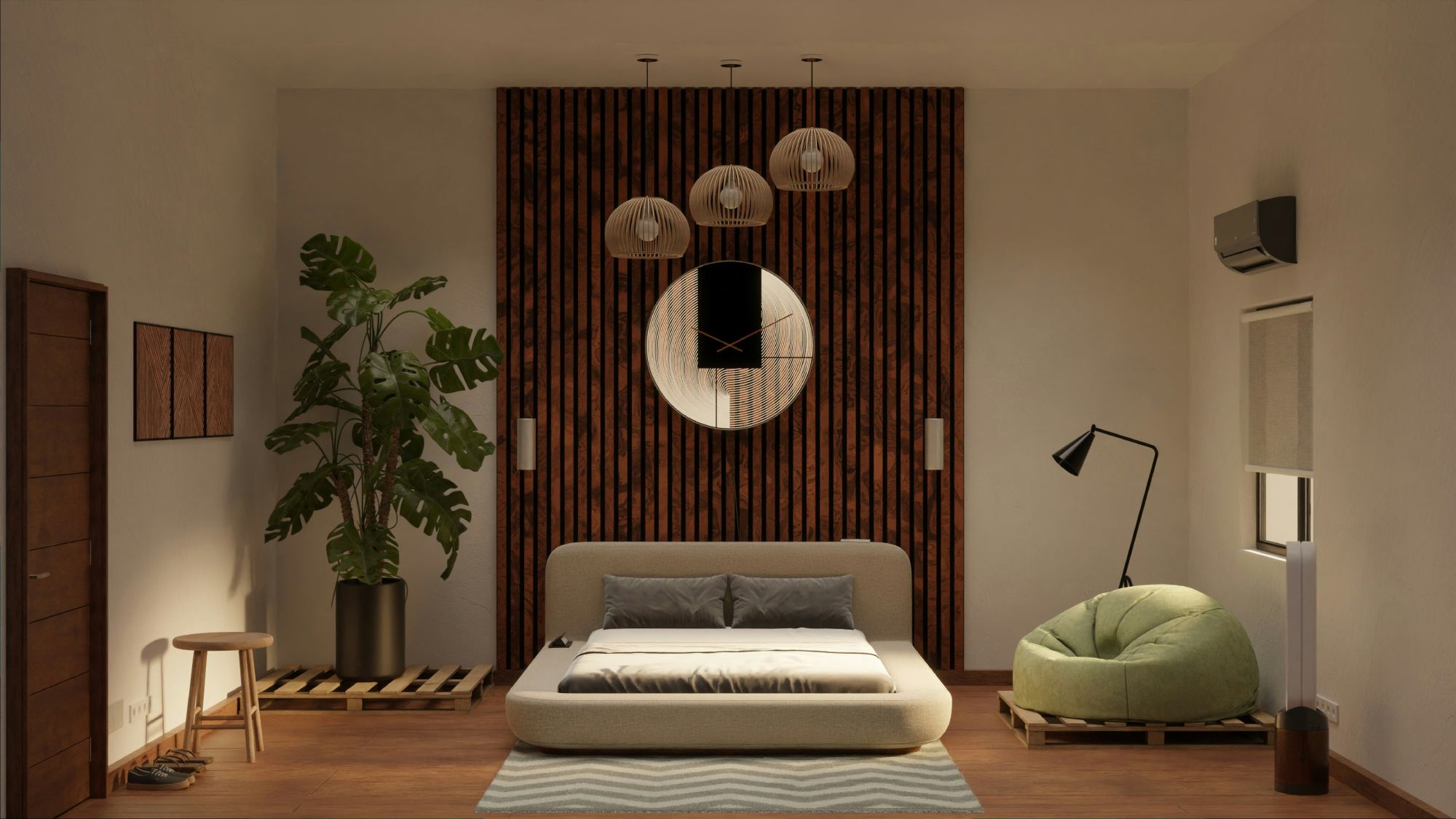
What does a Japandi home actually look like?
The first thing you notice in a Japandi space is what isn’t there. No clutter on the counters. No decorative items that don’t serve a purpose. No colors competing for your attention. The room feels settled and deliberate, like every single thing was chosen carefully.
Here are the core elements you’ll find in almost every Japandi space:
- Natural materials. Wood, linen, stone, bamboo, and rattan show up everywhere. These materials feel warm and organic without being heavy or flashy.
- A neutral color palette. Japandi uses warm whites, soft beiges, muted greens, earthy taupes, and charcoal grays. These colors work together without clashing and make a room feel larger.
- Low-profile furniture. Beds, sofas, and tables sit closer to the ground in Japandi spaces. This keeps the eye level low and opens up the visual space above.
- Clean lines with soft edges. Furniture has simple, geometric shapes, but the corners are slightly rounded, not sharp. This keeps the look modern without feeling cold.
- Plants and organic shapes. A single potted plant, a curved ceramic vase, or a woven basket adds life to a Japandi room without breaking the clean look.
- Intentional empty space. In Japandi design, empty wall space or a bare corner isn’t a mistake. It’s part of the design. Space itself is treated as a feature.
“In Japandi design, empty space isn’t a problem to solve. It’s the point.”
Why Japandi works so well in small spaces
Most design styles were created for large homes. They look great in a sprawling open-plan living room or a master bedroom the size of a tennis court. But try to apply them to a 600 square foot studio and they fall apart fast.
Japandi is different. Almost every principle it follows also happens to be a best practice for small-space design. Here’s why it works so well:
It removes visual clutter
Small rooms feel smaller when they’re full of competing visual element; busy patterns, too many colors, decorative objects on every surface. Japandi strips all of that away. When your eye has less to look at, the room feels calmer and more open, even if the square footage hasn’t changed.
It uses low furniture to free up vertical space
One of the best tricks for making a small room look bigger is keeping furniture low to the ground. It draws attention to the height of your walls and ceilings. Japandi’s preference for low-profile beds, sofas, and tables makes this easy. You get stylish furniture that also makes your space feel taller.
The color palette expands the room visually
Japandi’s warm neutrals — soft whites, sandy beiges, warm grays — all reflect light naturally. Light colors make walls feel farther away and rooms feel bigger. The cohesion matters just as much as the individual colors. When your walls, floors, and furniture all share the same warm neutral family, the room reads as one unified space instead of a bunch of separate pieces crammed together.
It celebrates purposeful furniture
Japandi design doesn’t do excess. Every piece of furniture belongs there for a reason. That mindset is exactly what you need in a small space. When you stop buying things you don’t need and start choosing pieces that do more than one job — a storage bench that also provides seating, a low bookshelf that also defines zones — your small home transforms.
Natural materials feel warm, not heavy
Small spaces need warmth, but they can’t handle heavy, bulky materials. A solid dark wood dining table can overwhelm a small dining area completely. Japandi solves this with lighter woods like oak, ash, and bamboo — materials that feel organic and warm without dominating the room. Pair them with linen textiles, and you get a space that feels genuinely cozy without feeling stuffed.
How to start bringing Japandi into your home
You don’t need to redecorate your entire home to get the Japandi effect. Start small. These five steps will move you in the right direction without overwhelming you or your budget:
- Edit first, buy later. Before you add anything new, take things away. Remove items from surfaces and shelves. Live with the empty space for a week. You might be surprised by how much better the room already feels.
- Switch to a warm neutral palette. If your walls are bright white or a bold color, consider repainting with a warm white, greige, or soft clay tone. This one change does more for a small room than almost any furniture swap.
- Replace one piece of furniture with a lower-profile version. Swap a tall dresser for a low credenza. Trade a chunky sofa for a streamlined one that sits closer to the floor. You don’t have to replace everything at once.
- Add one natural material. A jute rug, a rattan basket, a wooden tray, or a linen throw can start to shift the feel of a room toward Japandi without a full overhaul.
- Bring in one plant. A single plant — especially a simple one in a plain ceramic pot — adds life and a natural element that ties the whole look together.
“You don’t need to start over. Japandi is a direction, not a destination.”
What Japandi is not
Japandi gets confused with a few other styles, so it helps to know the differences.
It’s not the same as plain minimalism. True minimalism can feel stark and cold, like a hotel lobby that nobody actually lives in. Japandi keeps the simplicity but adds warmth through texture, natural materials, and cozy textiles. A Japandi room feels lived in. A purely minimalist room sometimes doesn’t.
It’s not Scandinavian hygge, either. Hygge-inspired spaces lean heavier on candles, knitted throws, and layered soft furnishings. Japandi is more restrained — it brings coziness through quality and texture rather than quantity.
And it’s not a rigid set of rules. Japandi is a philosophy more than a checklist. If something feels calm, intentional, and connected to nature, it probably belongs in a Japandi space — even if it doesn’t fit a specific category.
The bottom line
Japandi isn’t just a trend. It’s a practical approach to living well in a small space. It asks you to be intentional about what you bring into your home, to value quality over quantity, and to let simplicity do the work that square footage can’t.
If you’ve been struggling to make your small home feel calm, beautiful, and functional all at the same time: Japandi might be the answer you’ve been looking for.
To start, check out Japandi products for your home. You can always start small and go from there.